

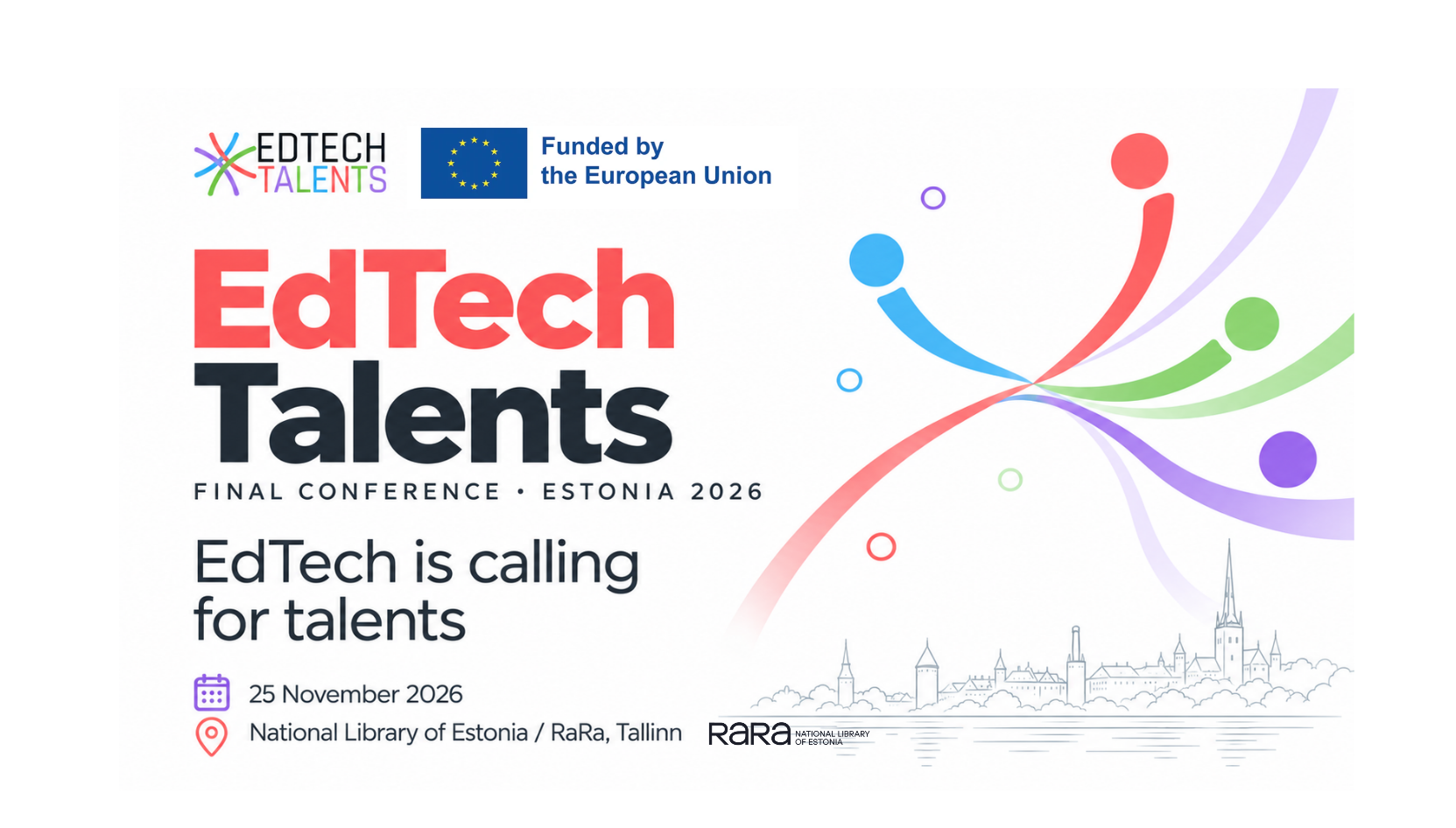
Try the tools. Meet the researchers and companies
Tallinn University at National Library of Estonia / RaRa, Tallinn
November 25, 2026
How do good research ideas become tools that improve learning? EdTech Talents is a European Commission-funded ERA Talents project bringing together researchers and EdTech companies from six European countries to make this happen through international exchanges, mentoring and collaboration.
Now you can meet the people behind that work. Explore expertise spanning educational robotics, STEAM and inclusive digital learning, try EdTech solutions and talk directly with the researchers and entrepreneurs developing them.
Bring a teaching challenge, a product idea or a research question. Join practical workshops, discover expertise that could help your work and find partners for your next project. Look out for vouchers offering a free one-hour expert consultation to take the conversation further.
Eight workshops · Six countries · Talks, demos, posters and new connections
Registration
All participants must register for the event. Participation is free of charge. Please note that onsite places are limited.
Practical information
Time: 25. November 2026
Venue: Estonian National Library (RaRa; Tõnismägi 2, 10122 Tallinn)
https://maps.app.goo.gl/8vM9Epxv7hgGKpzGA
Location: Main hall, 6th floor
Registration & cloakroom: 1st floor
Workshops: 5th floor
Please note: The National Library has been undergoing extensive reconstruction since 2021 and will fully reopen to the public in May 2027. Until then, the building is closed to general visitors but open for scheduled events and conferences.
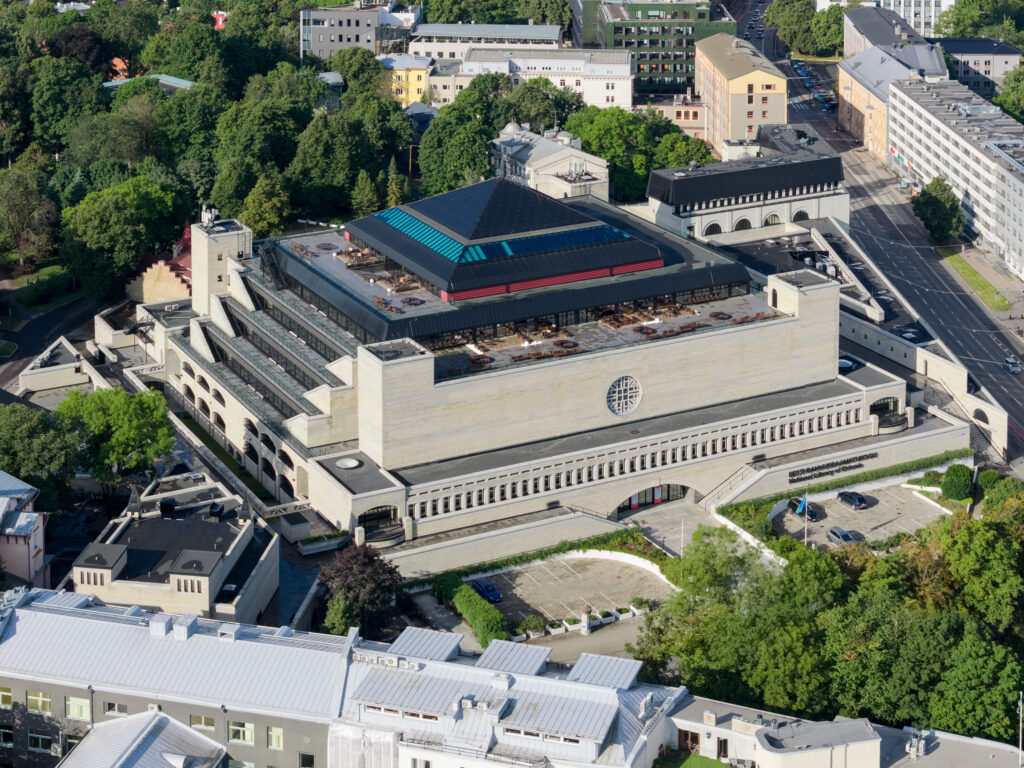
Photo by Martin Siplane
Meet the Event Contributors
Dr. Janika Leoste
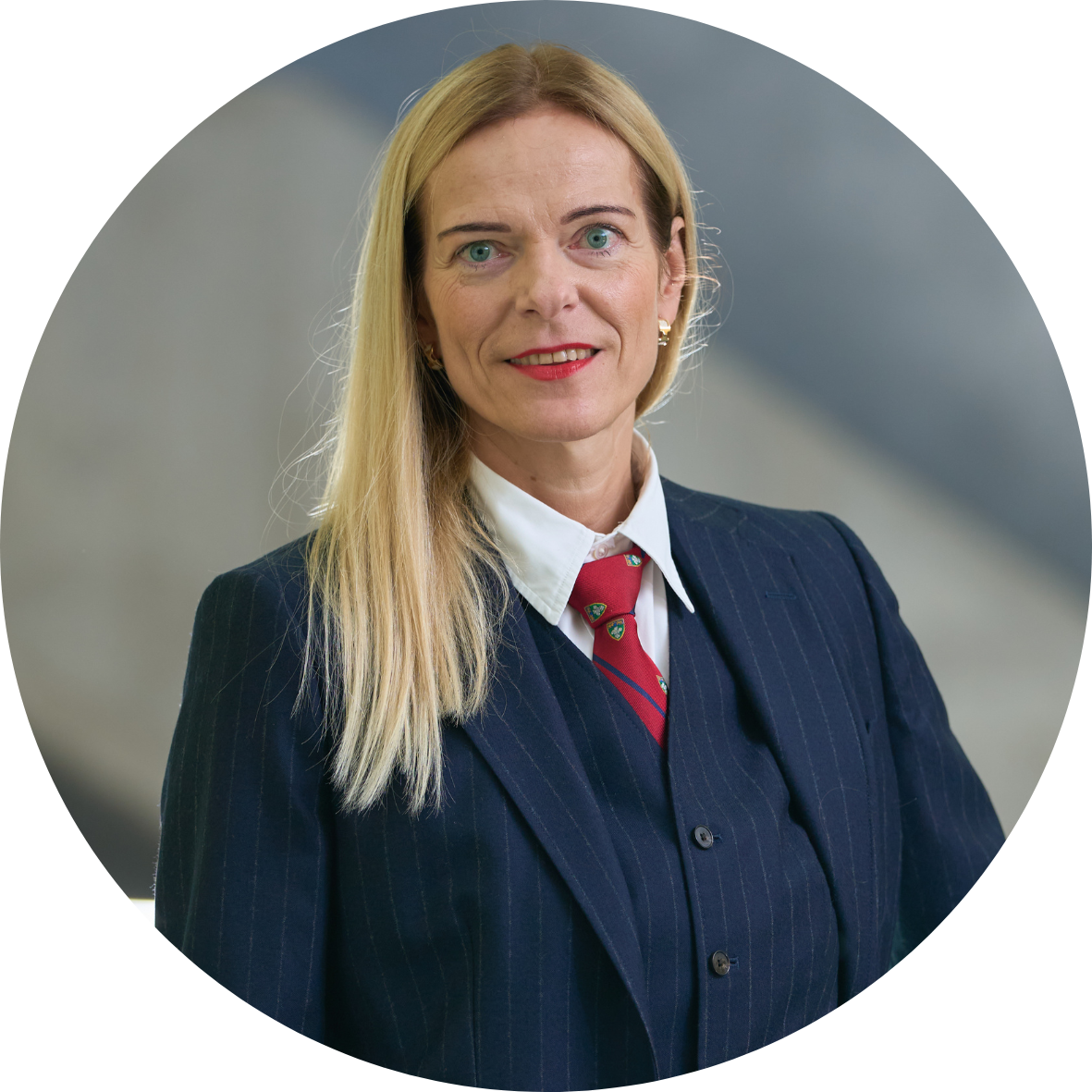
Dr. Janika Leoste is Associate Professor of Artificial Intelligence Didactics at Tallinn University and Assistant Professor at Tallinn University of Technology. Her research focuses on AI in education, educational robotics, telepresence robots, hybrid learning, and digital innovation in teaching and learning. She is the Principal Investigator of the EdTech Talents project.
Tiia Õun

Tiia Õun is the Director of the School of Educational Sciences and Head of the Teacher Education field at Tallinn University. Her research has focused on the quality of education and innovation.Tiia Õun participated in several research groups dealing with teacher professionalism, innovative learning and teaching methods and the quality of education in the context of education policy.
Tiina Pajuste

Tiina Pajuste is the Vice-Rector for Research at Tallinn University. Previously she was Professor of International Law and Security Studies. As Vice-Rector for Research, she is responsible for the strategic development of research and for strengthening the university’s research capacity and international cooperation. Her research focuses on the responsibility of international organizations, the role of international law in peace processes, and digital human rights
Martin Öövel

Martin Öövel is the Director General of the National Library of Estonia (RaRa), a position he has held since September 2023. He has a background in IT law and extensive experience in public-sector IT management, change management and education. Before joining RaRa, he was director of Tabasalu School and Keila School and has also been a lecturer at the University of Tartu.
Dr. Borut Čampelj

Dr Borut Čampelj is a policy officer (secretary) in the Digital Education Unit of the Ministry of Education, Science and Youth in Slovenia. He is an expert in the development of teacher training and support, digital pedagogy, interactive e-materials and R&D projects co-financed by the national programmes, European Social Fund, Recovery and Resilience Fund, Erasmus+, Digital Europe. He is a member of the expert groups in Slovenia and the EU (digital education, STEM, AI) and an author of various articles in scientific and professional journals as well as a panellist at national and international conferences.
Dr. Uglješa Marjanović

Dr. Uglješa Marjanović is a Professor of Industrial Engineering and Management at the University of Novi Sad and currently serves as a Managing Director of Frankfurt School Solutions GmbH branch office Serbia, a subsidiary of the Frankfurt School of Finance and Management.
He has earned his PhD degree in Industrial Engineering at the University of Novi Sad, Serbia, and was a postdoctoral researcher in the School of Mathematics, Computer Science & Engineering at the City University London. Ugljesa held visiting posts at Bloomsburg University, Penn State University, and helped set up the Cisco Entrepreneur Institute at the University of Novi Sad in Serbia.
He has also been an Adviser to the Minister of Innovation at the Government of Serbia. Developed numerous policy recommendations and reports in digital education.
His research, teaching, and advisory activities are at the intersection of strategy, innovation, digital education, and industrial engineering. His preferred research methods are field surveys, interviews, and observations, as well as multivariate statistical analysis.
Ugljesa’s research has been published in well-established academic journals, Information and Management, Information Systems and e-Business Management, International Journal of Managing Projects in Business, Advances in Production Engineering and Management. He is an Editor-in-Chief for the International Journal of Industrial Engineering and Management and a full member of IFIP WG5.7.
He led numerous national and international projects and provided several consultancies, such as EC, ETF, JRC, USAID, UNDP, UNICEF, World Bank, Microsoft, ERI SEE, PwC. Ugljesa was also a branch manager at Tangled – a startup offering state-of-the-art AI solutions, as well as a managing director of efiport GmbH branch office Serbia.
Liis Siiroja

Liis Siiroja
As CEO of EdTech Estonia and a board member since 2023, I lead a passionate community driving the future of education. Our mission is bold: to establish Estonia as the world’s leading EdTech nation. We connect, represent, and empower Estonian Ed Tech companies through collaboration, advocacy, and international partnerships- fostering a learner-first ecosystem that inspires global innovation.
In addition, I’m the co-founder and CEO of KideoCall, an Ed Tech supporting expat families in maintaining their children’s native language(s) and cultural ties through online playgroups. As a parent to multicultural children, I deeply relate to the joys and complexities of raising kids in multilingual, cross-cultural environments.
Though my professional roots are in communications, education has always been my passion. I previously led communications for Tagasi Kooli (Back to School), helping bridge the gap between students and the working world. I’m also active in the Estonian Montessori Association, championing interest-led learning and self-directed education. My journey in education began hands-on-as a camp counselor, kindergarten assistant, and substitute teacher.
Merle Pajus

Merle Pajus coordinates and manages the research administration and development activities at Tallinn University’s School of Educational Sciences (HTI) in order to support and increase the school’s and university’s readiness and ability to contribute to solving societal and economic challenges.
Branco Spasic

Branko Spasić is Head of the Office for Study Programs and Accreditation at the Faculty of Technical Sciences, University of Novi Sad. He has more than 18 years of experience in higher education administration, with expertise in study programme accreditation, quality assurance, academic administration, and institutional development. He is also actively involved in international cooperation and Erasmus+ projects, contributing to project management, quality assurance, digital transformation, and the modernization of higher education.
Dr. Luis Pastor

Dr. Luis Pastor is full Professor at the School of Computer Science & Engineering in the Rey Juan Carlos University (Madrid, Spain). His research interests include the use of technology in areas such as Education, Health and Training. Latest work includes using computer imaging, games and transmedia-like approaches for children with mild neurodevelopmental disorders.
Dr. Piedad Tolmos

Piedad Tolmos is a Professor at Universidad Rey Juan Carlos (Madrid, Spain), where she combines her academic activity with departmental leadership as Director of Department. Her research focuses on Mathematics Education, mathematics teacher training, and the application of digital technologies and artificial intelligence to enhance teaching and learning processes in higher education. She has published extensively in these fields and actively leads and participates in international and local research projects, and educational innovation initiatives.
Leno Kuura

Leno Kuura is Export Director at Bizplay OÜ and an adult trainer in teamwork at Ettevõtlusküla (Enterprise Village). Her work centres on one question: how strong collaboration and a conscious team culture help organisations grow. She is a Belbin Accredited Practitioner who develops team competencies through gamification and experiential learning. From 2018 to 2020, she served as Executive Director of Ettevõtlusküla, which received the title “Entrepreneurship Education Promoter of the Year” from the Estonian national programme “Edu ja tegu” during his tenure. Since 2026, she has been a Board Member of EdTech Estonia.
Dr. Martin Sillaots

Dr. Martin Sillaots is an Associate Professor of Serious Games at Tallinn University, Estonia, where he teaches courses such as Agile Project Management, Master’s Thesis Seminar, and Design of Serious Games. He is also a game designer, educator, project manager, and the founder of Ludoguru OÜ.
Sebastian Schwäbe

Sebastian Schwäbe is a project manager specialising in European cooperation projects, including Interreg, Horizon, and Erasmus+, with a particular focus on digital education, competence-oriented learning, and validation. His work is situated at the intersection of educational innovation, competence development, and the pedagogically grounded integration of emerging technologies, especially artificial intelligence as well as augmented and immersive reality.
Rather than treating these technologies as mere technical novelties, his perspective emphasises their pedagogical relevance, their didactic potential, and the conditions under which they can make a meaningful contribution to teaching, learning, and continuing professional development across different institutional contexts.
A central aspect of his work is the design and implementation of structured learning concepts that connect digital innovation with sustainable competence development. In this context, he draws particularly on the approach of competence-oriented learning and validation, which seeks to make learning processes more transparent, practice-oriented, and outcome-oriented.
The LEVEL5 approach provides an important conceptual foundation for this work, as it supports the differentiated description and assessment of competences across the dimensions of knowledge, skills, and attitudes. On this basis, his work contributes to the development of educational formats and project activities that combine methodological clarity with practical relevance for learners, educators, and organisations engaged in processes of digital transformation.
Dr. Cristina Popescu

Dr. Cristina Popescu is senior lecturer and researcher in digital literacy and inclusive education at Bielefeld University, Germany. With extensive international experience, she has previously collaborated as an expert with EASNIE-UNESCO, UNICEF and the French Ministry of Education.
Her current research draws on pragmatist approaches and on science and technology studies. It focuses on professionalization in the edtech sector from an international perspective, as well as on the ways knowledge and expertise move between science, technology and the wider public. In her work with student teachers, she also explores the technological and practical conditions for a more democratic and inclusive education of tomorrow.
She is the institutional lead at Bielefeld University for the Horizon project EdTech Talents and the organizer of the event “Rethinking quality and accountability in educational technologies”.
Antoanneta Potsi

Antoanneta Potsi is an Academic Staff at Bielefeld University
Andres Karjus

Andres Karjus has been a Lecturer in Digital Humanities and Artificial Intelligence at Tallinn University’s School of Digital Technologies (TÜHI) since 2024, following a postdoctoral fellowship with the CUDAN (Cultural Data Analytics) research group, funded through the Horizon ERA Chair programme. He holds a PhD in Linguistics from the University of Edinburgh, a Master’s degree in Artificial Intelligence from KU Leuven, and Bachelor’s and Master’s degrees in Estonian and Finno-Ugric Linguistics from the University of Tartu.
His research focuses on change in language and culture, using quantitative and experimental methods as well as artificial intelligence. In collaboration with researchers at Tallinn University and other universities, he has studied topics including complexity in language and art, media ecosystems, social media, film festivals, and the use of AI in research, education, and the arts. He is also active in developing cross-sector collaboration and science communication and received Estonia’s “Nationally Recognised Science Communicator” quality label in 2024.
Dr. José María Cañas

Dr. José María Cañas is a telecommunication engineer (1995) and PhD (2003) by U.Politécnica de Madrid. Cofounded the RoboticsLabURJC at Universidad Rey Juan Carlos (URJC) in 2000, where he holds a tenured position as Full Professor. He was member of Robot Learning Lab at Carnegie Mellon University (USA), did research at the Georgia Insitute of Technology (USA) and at the Instituto de Automática Industrial. He researches and regularly publishes scientific papers on AI driven Robotics and Robotics Education. He participates and leads competitive projects and private technological projects for companies. He teaches several courses on the same topics at bachelor degree and master degrees, has advised 10 PhD theses (+5 ongoing) and 40 Master theses.
He also leads the non profit JdeRobot organization (https://jderobot.github.io://jderobot.github.io), which develops open source software on Robotics and AI and develops robot programming tools. It has been selected by Google for its calls GSoC-2015 and 2017-2026, with more than 47 international contributors.
Alvaro Quintana Camacho

Alvaro Quintana Camacho is a Graduate in Software Robotics Engineering and FinTech Master student. I have worked at JdeRobot organization on the Unibotics robot programming platform, where I help support new and different robots and various programming languages to make the platform more complete
Dr. Kristjan Kask

Dr. Kristjan Kask is an Associate Professor in Forensic Psychology at Tallinn University (Estonia). His research focuses on developmental aspects in investigative interviewing of child and adult witnesses.
Gerald Infanger

Gerald Infanger is CEO, CTO, and the original idea giver behind MatheArena, an EdTech platform that grew from a 2014 spare-time project into a mathematics learning app with over 100,000 downloads and 2 million tasks solved each year. An inventor and innovator, he specializes in AI in education and holds a BSc in Psychology, complemented by his background as a trained mathematics teacher. This blend of pedagogy, psychology, and technology shapes MatheArena’s adaptive approach to learning. Together with co-founder Eva-Maria Infanger, Gerald has built MatheArena FlexCo with support from the Linz-based incubator tech2b, partnerships with Austria’s largest schoolbook publisher Veritas, and translations into several languages. His mission is to use technology and AI to make mathematics more meaningful, accessible, and engaging for learners everywhere.
Dr. Zsolt Lavicza

Univ-Prof. Dr. Zsolt Lavicza, PhD. Linz School of Education, STEAM Education Centre, Johannes Kepler University, Linz, Austria
Zsolt Lavicza has worked on several research projects examining technology and mathematics teaching in classroom environments at the Universities of Michigan and Cambridge. In addition, Zsolt has greatly contributed to the development of the GeoGebra community and participated in developing research projects on GeoGebra and related technologies worldwide. Currently, Zsolt is a Professor in STEAM Education Research Methods at Johannes Kepler University’s Linz School of Education. From JKU, he is working on numerous research projects worldwide related to technology integration into schools; leading the doctoral programme in STEAM Education; teaching educational research methods and coordinating research projects around the world.
List of Publications:
https://scholar.google.at/citations?hl=en&user=1526ABEAAAAJ&view_op=list_works&sortby=pubdate
http://researchgate.net/profile/Zsolt-Lavicza/
https://www.scopus.com/authid/detail.uri?authorId=35269199400
Dr. Eva Ulbrich

Dr. Eva Ulbrich is an educational scientist specialising in STEAM education, maker education, digital fabrication, and teacher education. She received her PhD from Johannes Kepler University Linz in 2026 with a dissertation on the development of the 3D-STEAM framework supporting teacher engagement with 3D modelling and 3D printing (3DMP). Before entering academia, she worked professionally with 3D design and digital fabrication in industry, developing and producing 3D models and prototypes.
Her research focuses on integrating emerging technologies into inquiry-based STEAM and mathematics education and on supporting teachers in working with complex technologies in the classroom. She has contributed to several European projects developing experimental learning activities, teacher training programmes, and approaches to AI and computational thinking in education. Her current work increasingly addresses the educational use of artificial intelligence and large language models, including teacher competencies, Human-AI interaction, and responsible implementation in educational settings.
Dr. Slavko Rakić

Dr. Slavko Rakić is a Research Professor at Tallinn University of Technology (TalTech), Estonia, and an Assistant Professor at the University of Novi Sad, Serbia. His research focuses on artificial intelligence in education, intelligent assessment, technology-enhanced learning, digital transformation, and educational innovation. He is actively involved in numerous European and international research and innovation initiatives, including Horizon Europe, Erasmus+, CERV, COST Actions, and other European-funded projects, with particular emphasis on responsible AI integration, digital competencies, innovative learning and assessment approaches, and technology-supported educational transformation. Within the Horizon Europe EdTech Talents project, Dr Rakić contributes to knowledge sharing, research, and the evaluation of educational technologies, and during the project he developed the Usability Platform Test (UPT), a solution designed to support the systematic evaluation of the usability and user experience of digital and educational technologies: https://usabilityplatformtest.com/.
Eva-Maria Infanger

Eva-Maria Infanger is the founder of MatheArena, an EdTech platform that grew from a 2014 side project into a mathematics learning app with over 100,000 downloads and 1.5 million items solved by learners. Finishing a Ph.D. from the Linz School of Education in adaptive learning for STEM, Eva-Maria combines academic expertise with a mission to make mathematics more accessible – building MatheArena FlexCo into a company with partnerships across Austria and translations reaching Indonesia, Turkey, Brazil or Estonia.
Contacts of organisers

Sirly Väät
Event Coordinator
Tallinn University
sirly.vaat@tlu.ee
Janika Leoste
Event Coordinator
Tallinn University
janika.leoste@tlu.ee
